What Is Insulin Resistance and Why Does It Matter for Indian Women?
Insulin resistance is a condition where your body's cells stop responding to insulin the way they should. When that happens, your pancreas just keeps making more insulin and that extra insulin is behind so much of what Indian women get told is "just stress" or "just age." The belly fat that won't shift. The sugar cravings at 4pm. The fatigue after a perfectly normal lunch. The dark patch on your neck that nobody explains.
It is one of the most underdiagnosed conditions in India, particularly in women. Many doctors don't test for it. Blood sugar can look normal for years while fasting insulin is already high. By the time it shows up on a routine test, it's often been there for a decade.
Here's what actually matters: it is reversible. Not with a crash diet or imported supplements. With a smarter approach to the rice, dal, roti, and sabzi your family already cooks. Namita reversed her own insulin resistance and has helped hundreds of Indian women do the same.
How Insulin Resistance Actually Develops
Think of insulin as a key and your cells as locks. In a healthy body, the key fits perfectly insulin opens the cell door, glucose enters, and your energy stays stable. With insulin resistance, the locks get stiff. Insulin is still being made, but the doors aren't opening properly. Your blood sugar starts to climb. Your pancreas notices and makes even more insulin to compensate. For a while, it works. Blood sugar looks fine on a basic report. But fasting insulin is running high in the background and that's where the damage happens.
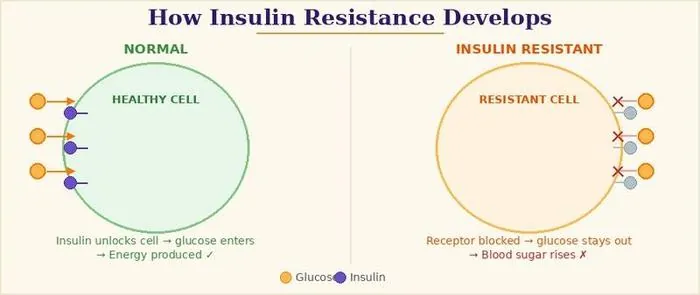
High insulin tells your body to store fat, especially around the abdomen. It disrupts sleep hormones. It drives up androgen production in the ovaries which is why 70% of Indian women with PCOS have insulin resistance at the root. It makes you hungry even when you've just eaten. And it makes you exhausted in a way that sleep doesn't fix.
Have you noticed that you feel sluggish after a meal of rice and dal, but feel fine after eggs and vegetables? That's your body telling you something. Post-meal fatigue is one of the clearest early signals that your cells are struggling to use glucose efficiently.
Symptoms of Insulin Resistance in Indian Women
- Dark velvety patches on the neck, underarms, or groin (Acanthosis Nigricans)
- Persistent fatigue, especially after meals
- Strong sugar or carbohydrate cravings, particularly mid-afternoon
- Belly fat that does not reduce even with dieting
- Difficulty losing weight despite calorie restriction
- Brain fog and difficulty concentrating after eating
- Irregular periods or PCOS diagnosis
Root Cause of Insulin Resistance
The root cause is chronic overstimulation of insulin receptors primarily through a diet high in refined carbohydrates and sugar, combined with physical inactivity. Over time, cells in muscle, fat, and liver stop responding to insulin's signal to absorb glucose. The pancreas compensates by producing more insulin, creating hyperinsulinaemia that drives fat storage, inflammation, and hormonal disruption. In Indian women, genetic predisposition to central fat storage amplifies this risk even at normal BMI.
🔬 The Test Your Doctor May Have Missed
A standard HbA1c or fasting glucose can appear completely normal while insulin resistance is already active. Ask your doctor specifically for: fasting insulin and HOMA-IR. These are the tests that actually catch it early before it becomes pre-diabetes.
Why Indian Women Are at Higher Risk
South Asians develop insulin resistance at lower BMIs than Western populations. A woman who is normal weight by standard charts can still have significant insulin resistance. This is partly genetic South Asian cells have a different fat distribution pattern, storing more visceral fat (around the organs) even at lower body weights. It's also dietary the traditional Indian meal is high in refined carbohydrates and low in protein, which is the exact combination that spikes insulin hardest.
This doesn't mean Indian food is the problem. It means the balance of Indian food matters enormously. Jowar roti instead of maida. Rajma instead of white rice alone. Curd with every meal. A handful of walnuts in the afternoon. These are not foreign interventions they're small shifts within your existing kitchen that change how your body responds to every meal.
Foods to Avoid with Insulin Resistance
- White rice in large portions : GI of 72; switch to small portions with dal and vegetables
- Maida products : bread, naan, biscuits, cake cause the sharpest glucose spikes
- Fruit juices & smoothies :fructose without fibre hits liver directly and worsens insulin resistance
- Packaged snacks : namkeen, chips, biscuits hidden sugar and refined starch
- Sweetened beverages : cold drinks, packaged chai, energy drinks
- Late-night carb-heavy meals : insulin sensitivity is lowest at night
Indian Diet Solution for Insulin Resistance
The most effective dietary approach for reversing insulin resistance focuses on stabilising blood sugar throughout the day not calorie restriction. Three principles guide the Indian approach:
- Always pair carbohydrates with protein and fat never eat rice, roti, or fruit alone. Add dal, curd, paneer, eggs, or a handful of seeds to every carb-containing meal.
- Prioritise low-GI Indian foods bajra, jowar, ragi, and brown rice over white rice in large portions; moong dal and masoor dal over processed snacks.
- Use metabolic spices daily methi seeds soaked overnight, haldi with black pepper, dalchini (cinnamon) in tea or dahi all clinically shown to improve insulin sensitivity.
Insulin Resistance Foods to Eat and Avoid, by Everyday Indian Kitchen Group
Nothing here needs a special shop or an imported ingredient. This is the same kitchen, with the balance moved a little.
| In your kitchen | Eat freely | Keep small, pair with protein | Why it matters |
|---|---|---|---|
| Grains and rotis | Bajra, jowar, ragi, whole wheat with the bran left in, hand-pounded or brown rice | White rice, maida roti, naan, poha and upma eaten on their own | The slower a grain releases its sugar, the less insulin your body has to send after it |
| Dals and protein | Moong, masoor, chana, rajma, paneer, curd, eggs, fish, chicken | Fried dal preparations, heavily creamed gravies | Protein at every meal is the single change that steadies the rest of the plate |
| Vegetables | All green sabzi, lauki, tinda, bhindi, cabbage, beans, salad before the meal | Potato, arbi and yam served as the main item | Fibre first slows everything that follows it down the same meal |
| Fruit | Guava, jamun, papaya, apple, pear, berries, eaten whole | Mango, chikoo, grapes, banana, and all fruit juice | Whole fruit comes with its own brake. Juice has had that brake removed |
| Fats and nuts | Ghee in normal quantity, mustard and groundnut oil, almonds, walnuts, seeds | Reheated frying oil, vanaspati, packaged namkeen | Fat is not the enemy here. The kind and the reheating are what cause trouble |
| Drinks and sweets | Water, chaas, nimbu pani without sugar, unsweetened tea and coffee | Sugary chai, cold drinks, packaged juice, mithai and biscuits | Sugar in liquid form arrives fastest and is the easiest single thing to cut |
| Spices | Methi soaked overnight, haldi with black pepper, dalchini, jeera, adrak | Ready masala mixes with added sugar and starch | Small daily habits, not a cure on their own, but they cost nothing to add |
I have seen this play out again and again in my own practice. One client of mine had been cutting calories for years with almost nothing to show for it, and once we shifted the focus to treating her insulin resistance directly rather than eating less, her weight finally started to shift over the following months. I have lived a version of this myself too, which is part of why I recognise it so quickly in others, and I have written about that separately in my own insulin resistance story. With another client I used that same insulin first logic, not the same plan, and her weight barely moved for a long time, because her digestion and the particular pattern behind her insulin resistance were different, and it took real trial and error to find the combination that finally worked for her body. It is the clearest proof I have that insulin resistance in one body is not insulin resistance in another, the logic holds, but the plan has to be rebuilt around the person rather than copied from the last success.
Indian Meal Examples for Insulin Resistance
- Morning (7–8 am) : 2 boiled eggs or a small bowl of sprouts chaat + green tea (no sugar)
- Breakfast (9–10 am) : Besan chilla with mint chutney + 1 cup curd
- Lunch (1–2 pm) : 1 small katori brown rice + dal + sabzi (with ghee) + salad
- Evening snack (4–5 pm) : Handful of roasted chana or 4–5 walnuts + 1 small fruit
- Dinner (7–8 pm) : 2 multigrain rotis + palak paneer or fish curry + raita
Simple Insulin Resistance Meal Plan
If the full approach feels like a lot to hold in your head, this is the simple insulin resistance meal plan I start most people on. One structure, repeated, until it stops taking effort:
- Breakfast: something with protein in it, eggs, besan chilla, moong dal chilla or paneer, with curd. Never tea and biscuits, and never fruit on its own.
- Lunch: dal or rajma, a large sabzi, one or two millet rotis or a small katori of rice, and curd or salad alongside.
- Evening: roasted chana, makhana, or a few walnuts around 4 or 5 pm, so you reach dinner hungry rather than desperate.
- Dinner: lighter on the grain, heavier on the vegetables and protein, finished a couple of hours before you sleep.
- Every day: methi seeds soaked overnight in the morning, haldi with black pepper in your cooking, and a short walk after your two biggest meals.
Keep this simple meal plan for insulin resistance the same for two weeks before adding variety. Consistency shifts insulin faster than variety does.
Insulin Resistance Diet Plan for Weight Loss
If you have been dieting and the weight will not move, insulin resistance is usually the reason, not a lack of discipline. High insulin tells the body to store rather than release fat, so eating less while insulin stays high mostly makes you tired and hungry. An insulin resistance diet plan for weight loss works in the other order: bring insulin down first, and the weight starts responding to the same effort you were already making.
- Do not cut your food right down. Under-eating raises cortisol, and cortisol pushes insulin straight back up. Eat properly, just differently.
- Protein is the lever, not the calorie count. Protein at every meal keeps you full, protects muscle while you lose fat, and steadies blood sugar in a way calorie counting alone never does.
- Change the grain before you cut the grain. Millets and portioned rice with protein alongside will do more than a no-carb week you cannot sustain past Sunday.
- Walk after meals and protect your sleep. These two are unglamorous and they change how your body handles the same food.
- Expect the first change to be non-scale. Cravings settle and afternoon energy returns well before the weight moves, and that order is normal, not a sign it is failing.
Timeline for Improvement with Diet Changes
- Week 1–2 : Fasting glucose begins to stabilise; energy levels improve after meals
- Week 3–4 : Sugar cravings reduce noticeably; post-meal energy crashes lessen
- Month 2–3 : Fasting insulin levels start dropping; waist measurement may reduce
- Month 3–6 : HOMA-IR score (insulin resistance marker) shows measurable improvement on blood tests
- Month 6–12 : Sustained reversal possible with consistent diet, sleep, and movement
Note: Timeline varies based on severity of insulin resistance, genetics, sleep quality, and stress levels.
When to Seek Professional Help for Insulin Resistance
Consult a qualified nutritionist or endocrinologist if: your fasting insulin is above 15 µIU/mL on blood tests; you have been told your blood sugar is "borderline" or you have pre-diabetes; you have a family history of Type 2 diabetes; dietary changes over 3 months have not reduced symptoms; or you are trying to conceive and cycles remain irregular.
Insulin resistance is highly reversible with the right nutritional approach, but the earlier it is caught, the faster the correction. Where a thyroid result is also out of range, the thyroid diet plan guide covers how the two fit into one set of meals. A personalised diet plan based on your specific blood reports will produce significantly better results than a general diet.
What Happens When Insulin Resistance Gets Overlooked
Most people ignore the early signs a little tiredness, some belly fat, cravings they blame on willpower. But insulin resistance doesn't stay quiet. Left unaddressed, it quietly graduates into conditions that now have their own names, their own specialists, and their own prescriptions. Here's what it turns into:
🩺 Type 2 Diabetes
When your pancreas can no longer keep up with the demand for extra insulin, blood sugar stops being controlled at all. Pre-diabetes arrives silently and Type 2 follows. Insulin resistance is the stage before the stage. Catching it here changes everything.
If you have already been told your sugar is borderline, read the diabetes diet plan for Indian homes.
🌸 PCOS
High insulin directly tells the ovaries to produce excess testosterone. This disrupts ovulation, causes irregular periods, drives acne and hair loss, and builds cysts. For most Indian women with PCOS, insulin resistance isn't a side effect it's the starting point.
🫀 High Blood Pressure
Chronic high insulin causes the kidneys to retain sodium and signals blood vessels to tighten. Blood pressure climbs not because of salt, not because of stress alone, but because the underlying insulin problem was never addressed.
🫁 Non-Alcoholic Fatty Liver (NAFLD)
When insulin resistance increases fat breakdown in fat cells (a process called lipid decomposition in adipocytes), more free fatty acids flood the bloodstream. The liver absorbs the overflow and starts storing fat. NAFLD in India is rising fast and insulin resistance is at the root of most cases.
🧬 Abnormal Cholesterol & Triglycerides
Insulin resistance drives up triglycerides and small dense LDL (the harmful kind), while dropping HDL (the protective kind). Your lipid panel starts looking wrong not because of ghee or coconut oil, but because elevated insulin is running fat metabolism in the wrong direction.
💪 Muscle Breakdown
When cells can't use glucose for energy, the body starts breaking down muscle tissue instead. This is why insulin-resistant women often feel weak despite eating enough. It also worsens the problem less muscle means less insulin sensitivity, and the cycle deepens.
🍫 Uncontrolled Hunger
High insulin blocks leptin, the hormone that tells your brain you're full. So your hunger signals never switch off properly. You eat a full meal and still want more 40 minutes later. This isn't a lack of discipline. It's a hormonal signal being blocked by insulin.
🧠 Brain Fog & Mood Disorders
The brain depends on steady glucose. When insulin resistance disrupts that, concentration drops, memory gets hazy, and anxiety worsens. Research increasingly links insulin resistance to depression and early cognitive decline conditions that rarely get connected to metabolic health in routine consultations.
💡 The Common Thread
These aren't separate problems that happened to arrive together. They're different symptoms of the same underlying disruption. Treating each one with a separate medication while the insulin resistance continues is like mopping the floor with the tap still running. Fix the root, and many of these conditions improve often without a single prescription change.
Namita shares her personal journey with insulin resistance and Acanthosis Nigricans from being dismissed at 12 to reversing it and losing 28 kg using Indian food. For every woman who has been told "just eat less."
Read Namita's Story →Frequently Asked Questions: Insulin Resistance Diet Plan
What is a simple meal plan for insulin resistance?
Keep one structure and repeat it: a protein breakfast such as eggs, besan chilla or paneer with curd, a lunch of dal or rajma with a large sabzi and a millet roti or small portion of rice, a small evening snack of roasted chana or walnuts, and a lighter dinner finished two hours before bed. Add soaked methi seeds in the morning and a short walk after your two biggest meals.
Can an insulin resistance diet plan help with weight loss?
Yes, and it usually works better than eating less alone. When insulin stays high the body holds on to fat, so the plan brings insulin down first through protein at every meal, low-GI grains in sensible portions, enough food rather than a crash diet, walks after meals and proper sleep. Cravings and energy improve before the weight moves, which is the normal order.
What is the best insulin resistance diet plan for Indian women?
The best insulin resistance diet plan pairs every carb with protein or fat, prioritises low-GI grains like jowar, bajra and ragi over white rice and maida, and uses metabolic spices like methi and haldi daily. It focuses on stabilising blood sugar across the day rather than calorie restriction.
How much does an insulin resistance nutritionist consultation cost in India?
Consultations start at ₹550 for a single session. Because fasting insulin and HOMA-IR typically take 10–12 weeks to shift, most clients with insulin resistance choose the 3 Month Program. View pricing →
Can insulin resistance be reversed with an Indian diet alone?
Yes, in most cases. A structured low-GI Indian meal plan, pairing carbs with protein, prioritising millets over refined grains, and using metabolic spices, can measurably improve fasting insulin and HOMA-IR within 3–6 months, without medication in many cases.
What are the early signs of insulin resistance in Indian women?
Common early signs include stubborn belly fat despite diet efforts, sugar or carb cravings after meals, energy crashes in the afternoon, dark patches of skin around the neck or underarms (acanthosis nigricans), and difficulty losing weight even with calorie control.
How long does it take to reverse insulin resistance with diet?
Most women notice improved energy and reduced cravings within 2–4 weeks, with measurable changes in fasting insulin or HOMA-IR typically visible at the 3-month mark. Full metabolic reversal varies by individual and is best tracked with periodic blood work.
What are the symptoms of insulin resistance in women?
Common symptoms include belly fat, fatigue after meals, sugar cravings, dark neck pigmentation, difficulty losing weight, irregular periods, acne, and increased hunger.
Can insulin resistance happen in thin women?
Yes. Even thin women can develop insulin resistance, especially Indian women who may store more visceral fat despite normal body weight.
How can insulin resistance be reversed naturally?
Insulin resistance can improve through balanced meals, increased protein and fibre intake, regular movement, better sleep, stress management, and reducing ultra-processed foods and excess sugar.
Is insulin resistance linked to PCOS?
Yes. Insulin resistance is one of the major drivers of PCOS because high insulin levels stimulate excess androgen production from the ovaries.
What is the best insulin resistance treatment diet?
The most effective insulin resistance treatment diet is not a strict or restrictive diet but a repeatable insulin resistance diet meal plan built from foods already in an Indian kitchen. It puts protein in every meal, replaces large portions of white rice and maida with low-GI grains like jowar and bajra, and adds a metabolic spice such as methi or haldi daily. The same structure works as a general diet for insulin sensitivity, whether or not weight loss is the main goal.
- Reaven G.M. (1988). Banting lecture 1988. Role of insulin resistance in human disease. Diabetes, 37(12), 1595–1607. PubMed →
- Dunaif A. (1997). Insulin resistance and the polycystic ovary syndrome: mechanism and implications for pathogenesis. Endocrine Reviews, 18(6), 774–800. PubMed →
- Tabák A.G. et al. (2012). Prediabetes: a high-risk state for diabetes development. The Lancet, 379(9833), 2279–2290. PubMed →
- Bhatt D.L. et al. (2021). Cardiovascular risk reduction with icosapentaenoic acid for hypertriglyceridemia. New England Journal of Medicine, 384, 1280–1291. NIH PMC →
- World Health Organization. (2023). Diabetes. WHO Fact Sheet →