What Is Lean PCOS?
Lean PCOS is polycystic ovary syndrome in women with a normal or low BMI (below 25). Because they do not appear overweight, lean PCOS is frequently missed and misdiagnosed.
Why Does Lean PCOS Happen?
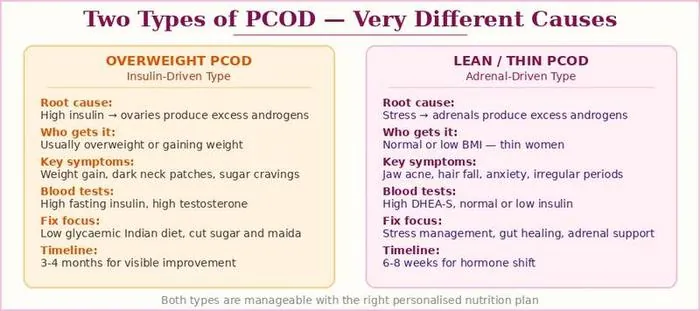
In lean PCOS, the primary driver is not insulin resistance but adrenal gland overactivity. The adrenal glands produce excess DHEA-S (an androgen), which disrupts ovulation without causing weight gain. Chronic stress, poor sleep, and over-exercising are key triggers.
Symptoms of Lean PCOS
Lean PCOS often presents differently from classic PCOS, which is why it goes undiagnosed for years:
- Irregular or absent periods despite normal body weight
- Acne, especially on the jawline or chin
- Hair thinning or hair loss on the scalp
- Anxiety, mood swings, and heightened stress response (adrenal PCOS)
- Fatigue and low energy even without exertion
- Difficulty conceiving despite apparently normal weight
- Bloating, gut issues, and blood sugar crashes between meals
Overweight PCOS vs Lean PCOS
| Feature | Insulin-Resistant PCOS | Lean / Adrenal PCOS |
|---|---|---|
| Body type | Overweight, especially abdominal | Normal or low weight |
| Primary driver | Insulin resistance → ovarian androgens | Adrenal glands → DHEAS overproduction |
| Key elevated hormone | Testosterone, insulin, LH | DHEAS, cortisol |
| Trigger | Refined carbs, sedentary lifestyle | Chronic stress, HPA axis dysregulation |
| Responds to | Low-GI diet, insulin management | Stress reduction, adrenal support, regular meals |
The TOFI Body Type
TOFI : Thin Outside, Fat Inside describes women who appear lean but carry high levels of visceral fat around internal organs. This visceral fat is metabolically active, produces inflammatory compounds, and contributes to PCOS symptoms even when the scale shows a normal weight.
Visceral fat is not visible from outside and doesn't show up in standard BMI. A waist measurement above 80 cm in Indian women, or a high waist-to-hip ratio, is a better indicator than BMI alone. Indian women are genetically more prone to this fat distribution pattern which is why lean Indian women can still have the metabolic features of PCOS.
Many doctors associate PCOS primarily with overweight women. When a thin woman presents with irregular periods, acne, or hair loss, PCOS is often not the first suspicion, leading to delays in diagnosis and incorrect treatment. Asking for a full hormonal panel including DHEAS is key.
I remember a client who spent years being told her symptoms could not be PCOS because she was not overweight, and it was only once we looked past her weight altogether that things started making sense for her body. The logic that helped her, calming stress and supporting her body's own rhythm rather than cutting food, worked well once we built the actual plan around her digestion and her daily routine. With another lean client I started from that same logic, not the same plan, and it still did not move the needle for a while, because her root cause turned out to be a different pattern altogether, and it took real trial and error before we landed on what her body actually needed. It is why I tell clients now that PCOS in a thin body is not one condition with one fix, the reasoning can carry over, but the plan almost never does.
Root Cause of Lean PCOS
The three main root causes in lean or adrenal PCOS are: (1) adrenal androgen excess elevated DHEA-S from chronic stress or adrenal hyperactivity; (2) HPA axis dysregulation the stress-response system is in a state of chronic activation; (3) thyroid dysfunction sub-clinical hypothyroidism can mimic lean PCOS patterns. Unlike the classical insulin-driven type, weight loss is not the treatment here.
Teede H.J. et al. (2018)'s international evidence-based PCOS guideline confirms that PCOS presents across a spectrum of body types, and that lean phenotypes driven by adrenal or stress-related pathways are a recognised, distinct presentation, not a misdiagnosis. Read on PubMed →
Blood Tests to Ask For
| Test | Timing | What It Shows |
|---|---|---|
| LH, FSH, Oestradiol | Day 2–3 of cycle | LH:FSH ratio; elevated LH supports PCOS diagnosis |
| Total testosterone + DHEAS | Day 2–3 | DHEAS elevated in adrenal PCOS; total T elevated in both types |
| Fasting insulin + glucose (HOMA-IR) | Fasting | Often normal or borderline in lean PCOS key differentiator |
| Cortisol (morning) | 8 AM, fasting | Elevated in HPA axis dysregulation |
| Thyroid (TSH, free T3/T4) | Any | Thyroid issues mimic PCOS symptoms |
| AMH | Any | Elevated in PCOS, reflects follicle excess |
| Pelvic ultrasound | Day 2–5 | Follicle count; polycystic appearance |
Indian Diet Solution for Lean PCOS
| Principle | Rationale |
|---|---|
| Regular meal timing no fasting | Skipping meals raises cortisol which directly increases DHEAS production in adrenal PCOS |
| Adequate carbohydrates | Very low carb diets raise cortisol counterproductive for adrenal PCOS |
| Prioritise stress-reducing foods | Magnesium, B vitamins, and omega-3 support HPA axis regulation |
| Avoid caffeine overload | Excess caffeine stimulates cortisol and adrenal activity |
| Protein at every meal | Stabilises blood sugar and reduces stress-related cortisol spikes |
| Sleep hygiene prioritised | LH pulsatility is controlled by circadian rhythm; consistent sleep restores it |
Key Nutrients for Adrenal PCOS
Alsi (Flaxseeds)
Lignans block androgen receptors peripherally; omega-3 reduces adrenal inflammation. 1 tbsp ground daily.
Spearmint Tea
Anti-androgenic reduces free testosterone. Particularly relevant for adrenal PCOS where androgens are directly elevated.
Zinc
Reduces 5-alpha reductase activity and adrenal androgen sensitivity. Found in pumpkin seeds, chana, cashews.
Magnesium
The most important mineral for HPA axis regulation. Reduces cortisol reactivity. Found in palak, dark chocolate, nuts, seeds, millets.
Ashwagandha
Well-studied adaptogen that reduces cortisol levels and improves adrenal resilience. Use with guidance stimulating for some at high doses.
Vitamin B6
Supports adrenal function and progesterone synthesis. Found in chickpeas, bananas, sunflower seeds, eggs.
PCOS and Weight Loss: Why It's Different for Lean Women
This is probably the most misunderstood part of lean PCOS. If you've been told to "just lose a little weight" that advice doesn't apply here. Lean PCOS isn't driven by excess fat. It's driven by cortisol and adrenal hormones. Trying to diet the same way as someone with insulin-resistant PCOS can actually make things worse.
Here's what most women with lean PCOS don't realise: your body is already under stress. Every time you skip a meal, cut calories too hard, or do intense exercise on an empty stomach, your adrenal glands respond by producing more cortisol and more cortisol means more DHEAS, which means more androgen symptoms. More acne. More hair fall. More irregular periods.
Why Standard PCOS Diets Fail Lean Women
The typical advice for PCOS weight loss goes like this: eat low carb, do intermittent fasting, cut calories, add more cardio. For insulin-resistant PCOS, this can work. For lean PCOS, this is almost the opposite of what you need.
- Intermittent fasting raises cortisol during the fasting window, which directly increases adrenal androgen production. Not suitable for adrenal PCOS.
- Very low carbohydrate diets cortisol goes up when blood glucose drops too low. Lean PCOS women often feel anxious, fatigued, and worse on strict keto or low-carb plans.
- Caloric deficit > 400 kcal/day signals nutritional stress to the HPA axis. The body responds by increasing cortisol and suppressing reproductive hormones.
- Intense daily cardio (HIIT, running, spinning) raises cortisol significantly post-exercise. For lean PCOS, high-intensity exercise done excessively worsens adrenal load.
- Under-eating protein blood sugar instability triggers cortisol release. Every energy crash is a cortisol spike.
Should You Even Try to Lose Weight with Lean PCOS?
This is a question worth asking honestly. If you're already at a healthy or low BMI, weight loss is not the goal. Hormone balance is. And sometimes, in lean PCOS, the goal is actually to eat more more regularly, more nutrients, more adrenal support not less. If that's your situation, the weight gain diet plan explains how to do this without it turning into random fried-food weight gain.
If you do have a small amount of visceral fat (the hidden TOFI pattern described above), the right approach is still not aggressive dieting. It's improving insulin sensitivity gently through food quality, not calorie restriction. Switching from refined carbs to millets. Adding protein at every meal. Reducing ultra-processed food. These changes improve body composition without triggering the cortisol spike that crashes your hormones.
| Goal | Right for Lean PCOS? | Better Alternative |
|---|---|---|
| Lose weight aggressively | ❌ Not recommended | Focus on hormone balance first |
| Reduce visceral fat | ✅ Yes, gently | Food quality + resistance training |
| Eat in a 500 kcal deficit | ❌ Worsens adrenal load | Eat at maintenance with better food choices |
| Cut all carbohydrates | ❌ Raises cortisol | Switch to low-GI carbs: bajra, jowar, oats |
| Add daily HIIT or running | ❌ Worsens adrenal PCOS | Walking, yoga, resistance 3×/week |
| Eat 3 meals + 1–2 snacks daily | ✅ Essential | Stabilises cortisol through consistent blood sugar |
Exercise for Lean PCOS: What Actually Helps
Movement matters but the type matters even more than the amount. The goal with exercise in lean PCOS is to improve insulin sensitivity and reduce inflammation without creating an additional cortisol burden.
- Walking 30–45 minutes daily the most underrated tool. Reduces cortisol, improves insulin sensitivity, and doesn't spike stress hormones.
- Resistance training 2–3 times per week builds muscle tissue which acts as a glucose sink. Reduces insulin resistance without raising cortisol when done in moderate sessions (under 60 minutes).
- Yoga or Pilates actively lowers cortisol through breath regulation and parasympathetic activation. Particularly useful for adrenal PCOS where HPA axis is overactive.
- Dance, cycling at a comfortable pace, swimming enjoyable moderate activity that doesn't feel like punishment. Consistency matters more than intensity here.
A practical rule: if you feel wired, exhausted, or anxious after exercise, that session was too intense for your current adrenal state. Scale back. The goal is to feel better after movement, not depleted.
Blood Sugar Management for Lean PCOS
Even in lean PCOS, cellular insulin resistance at the ovarian level is real. Your blood glucose numbers might look normal on a fasting test, but your ovaries can still be responding abnormally to insulin. This is why managing blood sugar rhythm not by cutting carbs, but by stabilising spikes matters.
Being slim does not take you out of this picture either. Indian women often run into blood sugar trouble at a weight that looks perfectly healthy from the outside, which is why a normal report today is not a reason to leave it alone. The eating rhythm described in the diabetes diet plan for India is built around exactly this, and it is worth knowing early rather than later.
The practical way to do this with Indian food:
- Start meals with vegetables or protein, not with rice or roti first
- Add a small amount of fat or protein to every carbohydrate ghee on roti, curd with rice, dal before khichdi
- Avoid eating refined carbs alone as a snack biscuits, bread, packaged snacks cause a rapid insulin rise
- Eat within 30–60 minutes of waking this sets your cortisol curve for the day
- Don't go more than 4 hours without eating during the day
Indian Foods That Help Lean PCOS (Not Just Weight)
These aren't weight-loss foods. They are foods that lower adrenal activity, stabilise hormones, and reduce the androgenic symptoms of lean PCOS. The result, for some women, is a gradual reduction in stubborn visceral fat but that's a side effect of hormone balance, not the goal.
Realistic Timeline for Lean PCOS Weight Changes
Honest answer: the timeline for body composition change with lean PCOS is 4–6 months of consistent eating. And the changes you'll notice first won't be on the scale. They'll be in how your clothes fit, reduced bloating, clearer skin, and more regular periods. Scale weight often doesn't move much and that's actually fine, because for lean PCOS, the goal was never really weight to begin with.
| Timeframe | What You'll Notice |
|---|---|
| Week 1–2 | Less bloating, better energy after meals, reduced afternoon crashes |
| Week 3–6 | Improved sleep quality, less anxiety, skin starting to settle |
| Month 2–3 | Period regularity improving, acne reducing, hair shedding slowing |
| Month 4–6 | Gradual reduction in visceral fat if present; hormonal markers improving |
Ask yourself: Am I skipping meals or fasting to "be good"? Am I doing intense cardio daily? Am I cutting carbs very low? If yes to any of these and your PCOS symptoms are persisting or worsening your approach may be raising cortisol and working against your hormones rather than with them. A personalised plan changes this.
Foods to Avoid with Lean PCOS
- Low-calorie crash diets : lean women often under-eat, which worsens cortisol and disrupts cycles
- Refined carbs : even at normal weight, high-GI foods drive cellular insulin resistance
- Excess raw vegetables : cruciferous vegetables (broccoli, cauliflower) raw in large amounts can suppress thyroid, common with lean PCOS
- Alcohol : impairs liver's ability to clear excess oestrogen and androgens
- Artificial sweeteners : disrupt gut microbiome which affects hormone metabolism
Timeline for Improvement with Lean PCOS
Lean and adrenal PCOS often responds faster to dietary changes than insulin-driven PCOS because the driver is cortisol and inflammation rather than deep metabolic resistance:
- Weeks 1–3: Reduced bloating, better energy, less mid-afternoon crashes after balancing blood sugar
- Weeks 4–8: Improved sleep, reduced anxiety, first signs of acne clearing
- Month 3–4: Period regularity starting to improve; hair shedding slows
- Month 5–6: Hormonal markers (LH, androgens) visibly improving on blood tests
When to Seek Professional Help
See a doctor or nutrition professional if:
- You have not had a period for more than 90 days
- You are trying to conceive and have been unsuccessful for 6+ months
- Hair loss is rapid or patchy (could indicate thyroid issues rather than lean PCOS)
- Your anxiety or mood symptoms are severe and affecting daily function
- Blood tests show very high DHEAS or cortisol levels adrenal tumours need to be ruled out
A proper diagnosis including ultrasound, LH/FSH, DHEAS, and fasting insulin is important before starting any hormonal or dietary protocol.
Frequently Asked Questions
📖 Explore More PCOS Topics
PCOS Diet India
Indian meal plan and food list for PCOS reversal.
Read Guide → WeightPCOS Weight Loss
Why diets fail and the insulin-first approach that works.
Read Guide → SkinPCOS & Acne
Hormonal jaw acne, androgen connection, foods that clear skin.
Read Guide → HairPCOS Hair Loss
Crown thinning, DHT, and nutritional interventions for regrowth.
Read Guide → CyclesIrregular Periods & PCOS
How to restore cycle regularity and understand anovulation.
Read Guide → InsulinInsulin Resistance Hub
The root cause guide insulin resistance and PCOS connection.
Read Guide → Weight ScienceWhy Dieting Isn't Working
For lean PCOS especially, standard dieting backfires here's the adrenal-aware approach instead.
Read Guide → Bone HealthOsteoporosis in Indian Women
Lean PCOS and low estrogen exposure both increase bone loss risk why bone health matters early.
Read Guide → Weight GainWeight Gain Diet Plan
If you've been told to "just gain weight", here's why that needs a careful, food-first approach for lean PCOS.
Read Guide → Blood SugarDiabetes Diet Plan India
What to eat for steady blood sugar, and how it connects back to insulin resistance.
Read Guide → Hindiइंसुलिन रेजिस्टेंस (हिंदी)
The same insulin resistance guide, in Hindi.
Read Guide → Storyनमिता की कहानी
Namita's own insulin resistance story, in Hindi.
Read Guide → StoryMy Insulin Resistance Story
Namita's own experience with insulin resistance, in her words.
Read Guide → HindiPCOS क्या है (हिंदी)
PCOS symptoms, types and the Indian diet approach, in Hindi.
Read Guide → Main GuidePCOS Complete Guide
The full pillar guide covering all PCOS types, causes and the Indian diet approach.
Read Guide → PMOSPCOS Renamed to PMOS
What the May 2026 rename means, and what does not change for your care.
Read Guide → ThyroidThyroid Diet Plan India
What to eat when an underactive thyroid is making weight and energy harder.
Read Guide → Hindiवजन कम करें, सही तरीका
Weight loss, in Hindi, with hormones and food explained together.
Read Guide →