What Is Osteoporosis
Osteoporosis is a condition where bones gradually lose their density and strength, making them fragile and prone to fractures. It earns its nickname as the "silent disease" because there is no pain, no visible change, no warning until a bone breaks from something as minor as a fall or a sudden bend.
Bones are living tissue, constantly being broken down and rebuilt. Osteoporosis happens when the breakdown outpaces the rebuilding leaving bones full of tiny holes, like a sponge. The stage just before this, called osteopenia, is where bones are weaker than normal but not yet fragile. Catching it here is the ideal window to act.
Why Does Osteoporosis Happen?
Bone is living tissue, it is constantly broken down and rebuilt throughout life. Until your mid-30s, bone is built faster than it is lost. After that, the balance shifts: bone loss begins to outpace bone formation. In women, this process accelerates sharply at menopause when oestrogen which normally slows bone breakdown drops. The result is a net loss of bone density every year after menopause, often reaching 2–3% per year in the first five years. Most women feel nothing during this process, which is why osteoporosis is only discovered after a fracture.
Both are measured by a DEXA scan using a T-score. A score between −1.0 and −2.5 is osteopenia reversible with nutrition and exercise. Below −2.5 is osteoporosis requires active medical and nutritional management. Most Indian women are never screened until after a fracture.
Symptoms
Osteoporosis genuinely has no early symptoms, this is what makes it dangerous. Bones can lose 30–40% of their density before any pain develops, and routine blood tests do not flag it. The first sign is often a fracture from a minor fall, a sneeze, or bending forward.
Later-stage warning signs include unexplained height loss (vertebrae compressing), a hunched upper back, persistent mid-back pain that worsens on standing, and receding gums or loose teeth which reflect the same calcium-depleted environment in the jaw bone. If any of these sound familiar, ask for a DEXA scan.
Root Causes in Indian Women
The root cause is a combination of lifelong calcium and Vitamin D deficiency, compounding during menopause when oestrogen which protects bone density drops sharply. Indian women face additional risk factors: low sun exposure (despite sunny climate, cultural clothing and indoor lifestyles limit skin synthesis), predominantly vegetarian diets low in bioavailable calcium, and high phytate content in cereals that blocks calcium absorption.
Indian women face a specific triple threat that makes them more vulnerable than most. First, diets are low in calcium the average Indian woman gets under 400 mg daily against a target of 1,000 mg. Second, Vitamin D3 deficiency is near-universal despite abundant sunlight, because darker skin, clothing coverage, and indoor habits block meaningful synthesis. Third, the sharp estrogen drop at menopause removes the hormone's bone-protective effect almost overnight.
Add to this that Indian women reach peak bone mass at lower absolute values than Western women (ICMR data), and the margin before fracture risk is much smaller to begin with. Bone loss can begin as early as 35 not 60.
A widely-cited review found vitamin D deficiency affects an estimated 70–100% of the general Indian population across every region studied, despite abundant year-round sunlight, this is the well-documented paradox behind why bone health risk starts so much earlier in Indian women. Read on PubMed →
Add to this that Indian women reach peak bone mass at lower absolute values than Western women (ICMR data), and the margin before fracture risk is much smaller to begin with.
Women with PCOS or PCOD who had irregular periods for years had less estrogen exposure during their peak bone-building years. This can push bone loss a decade earlier than menopause. A DEXA scan from age 35–40 is worth discussing with your doctor if you have a PCOS history.
I had a client come to me right after her mother had a hip fracture, worried she was heading the same way, and building her plate around calcium rich Indian foods alongside regular strength work made a real difference to how she felt over time. With another client going through her own menopause transition, I started from that same logic, not the same plan, and her body did not respond in the same way, because her digestion and where she was starting from were different, and it took some trial and error before we found what actually helped her. Even something as physical as bone health does not follow one script, the reasoning holds across women, but the plan itself has to be rebuilt for each one, and that is the part a generic diet chart cannot do for you.
Perimenopause and Menopause: What Actually Changes
Bone loss accelerates sharply around menopause, and most Indian women are given no preparation for it. Perimenopause, the transition, which typically begins in the early to mid forties and can last four to eight years, is when the change starts, not menopause itself.
Oestrogen restrains the cells that break down bone. As it falls, that restraint weakens and bone is resorbed faster than it is rebuilt. Women can lose up to 20% of their bone density in the five to seven years around menopause. There are no symptoms while it happens, which is precisely the problem.
| Symptom | What Is Happening | What Helps Nutritionally |
|---|---|---|
| Weight moving to the middle | Falling oestrogen shifts fat storage centrally and reduces insulin sensitivity | Protein at every meal, strength training, lower refined carbohydrate |
| Hot flushes, night sweats | Temperature regulation destabilised by hormonal fluctuation | Soy foods, flaxseed, limiting caffeine and alcohol in the evening |
| Broken sleep | Progesterone decline plus night-time temperature swings | Magnesium-rich foods, consistent timing, protein at dinner |
| Joint aches | Oestrogen has an anti-inflammatory role that is now reduced | Omega-3, turmeric, adequate vitamin D |
| Bone loss (silent) | Resorption outpacing formation | Calcium, vitamin D, vitamin K2, protein, weight-bearing exercise |
| Hair thinning | Relative androgen dominance as oestrogen falls | Protein, iron and ferritin, zinc |
The years before and during perimenopause are when nutrition has the greatest influence on your bone density for the rest of your life. Bone built in your thirties and forties is what you draw down later. Most Indian women are first told about bone health after a fracture in their sixties, which is two decades too late to do the most useful work.
Calcium-Rich Indian Foods (Per 100 g)
You do not need imported foods or supplements to meet calcium needs. Most of the best sources are already in an Indian kitchen.
| Food | Approx. Calcium (mg/100 g) | Note |
|---|---|---|
| Til (sesame seeds) | ~975 | The richest common Indian source. One tablespoon daily is meaningful. |
| Ragi (finger millet) | ~344 | Roughly three times the calcium of wheat. The single best grain swap for bone. |
| Ajwain | ~1,525 | Very high, though eaten in small quantities. |
| Paneer | ~208 | Also supplies protein, which bone equally requires. |
| Badam (almonds) | ~228 | A practical daily snack. |
| Curd / dahi | ~150 | Better tolerated than milk for many adults. |
| Sarson ka saag / methi | ~200–350 | Cook with a little fat to improve absorption. |
| Rajma | ~143 | Calcium alongside protein and fibre. |
You absorb only a fraction of dietary calcium without adequate vitamin D, and deficiency is near-universal in Indian women, including those who spend time outdoors. Darker skin needs considerably longer sun exposure to make the same vitamin D, most sun exposure happens fully clothed, and sunscreen blocks synthesis. Get the level tested rather than guessing. Vitamin K2, from fermented foods and cheese, then directs the calcium into bone rather than arteries.
Indian Diet Solution for Osteoporosis
Bone health is not just about calcium. Bones need a team: calcium provides the mineral, Vitamin D3 controls how much of it you actually absorb from food, Vitamin K2 directs calcium into bone rather than arteries, protein makes up 50% of bone volume as collagen, and magnesium activates Vitamin D3 in the body. A gap in any one of these quietly undermines the rest.
For most Indian women, all five are below target simultaneously. The practical starting point is not a supplement stack, it is getting a 25-OH Vitamin D blood test and serum calcium done first. Then building a diet around Indian foods that are genuinely rich in these nutrients. Also, if crash dieting or severe calorie restriction is part of your routine, it measurably reduces bone density even short-term.
| Nutrient | Daily Target | Avg Indian Intake | Gap |
|---|---|---|---|
| Calcium | 1,000–1,200 mg | ~400 mg | Critical |
| Vitamin D3 | 600–2,000 IU | ~100–150 IU | Critical |
| Vitamin K2 | 90–120 mcg | Very low | Critical |
| Protein | 0.8–1g/kg body weight | ~0.4–0.5g/kg | Moderate |
| Magnesium | 310–320 mg | ~200 mg | Moderate |
Foods to Eat and Avoid
Indian cuisine has some genuinely excellent bone-building foods the issue is consistency, not availability. Ragi at 344 mg of calcium per 100g is the best plant-based calcium source in Indian cooking. Til (sesame seeds) at 975 mg per 100g is extraordinary two tablespoons in a chutney or laddoo gives around 200 mg. These are everyday foods, not specialty items.
On the other side, excess salt accelerates calcium loss through urine, cold drinks block absorption with phosphoric acid, and more than 3–4 cups of chai or coffee daily increases urinary calcium excretion. These don't need to be eliminated just kept in check.
✅ Eat These Regularly
- Ragi roti or dosa (3–4×/week)
- Til in sabzi, chutney, or laddoo
- Moringa powder in dal or soup
- Dahi 1 bowl per day
- Paneer or milk (if vegetarian)
- Soaked almonds 8–10 daily
- Rajma, chana, moong regularly
- Palak sabzi with lemon
- Eggs 2 daily
- Sunflower and pumpkin seeds
- Desi ghee (small amounts)
- Amla fresh or powder
❌ Foods to Avoid for Bone Health: They Deplete Calcium
- Excess salt (increases urinary calcium loss)
- Cold drinks and sodas (phosphoric acid)
- 4+ cups chai or coffee daily
- Alcohol (suppresses bone-building cells)
- Highly processed packaged foods
- Crash diets or very low calorie eating
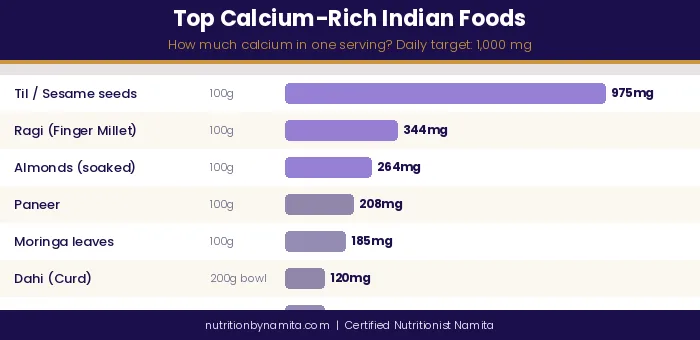
Ragi (finger millet) has 344 mg of calcium per 100g the most bioavailable plant calcium in Indian food. It also contains magnesium and phosphorus. Used as roti, porridge, or idli three times a week, it makes a real difference to daily calcium totals. Most Indian women eat it rarely or not at all.
Indian Meal Examples for Bone Strength
Breakfast: Ragi (nachni) porridge with milk + til (sesame) ladoo on the side. Ragi has the highest calcium content of any Indian grain. Lunch: Palak paneer + roti + curd (raita). Dinner: Rajma / chole + brown rice + sabzi cooked in ghee. Snack: Roasted chana + a small banana. Spend 15 minutes in morning sunlight daily for natural Vitamin D synthesis.
Prevention and Lifestyle
Diet handles the material; exercise gives bones the reason to use it. When muscles contract against resistance, they pull on bone signalling bone-building cells (osteoblasts) to lay down new tissue. Multiple trials show 2–3 sessions of resistance training per week can increase bone mineral density by 1–3% annually in postmenopausal women, effectively reversing the 1% annual loss that aging brings. Swimming and cycling are excellent for heart health but provide almost no bone stimulus because body weight is fully supported.
The best starting point for most Indian women with no gym access: squats, wall push-ups, standing lunges, calf raises, and brisk walking on uneven ground. 20–30 minutes, three times a week. This matters at every age including after 60. Combine this with getting a 25-OH Vitamin D test, fixing deficiencies, and eating calcium-rich Indian foods consistently. The tools are straightforward; the challenge is starting before the damage sets in.
Ages 25–35: Build your bone reserve now. Eat ragi, til, and dahi consistently. Strength training 3×/week. Get Vitamin D3 checked once.
Ages 35–45: Get a DEXA scan baseline. Start D3 + K2 if blood tests show low levels. Protein matters aim for 0.8–1g per kg body weight daily.
Ages 45+: This is the highest-risk window. Increase calcium to 1,200 mg daily. Resistance training is non-negotiable. Retest Vitamin D every 6 months.
Timeline for Bone Density Improvement
3 months: Vitamin D and calcium levels normalise with consistent supplementation and dietary change. Muscle strength and balance improve. 6–12 months: Bone turnover markers (P1NP, CTX on blood tests) show positive change. 1–2 years: DEXA scan may show measurable improvement in bone mineral density, especially at the hip and spine. Note: bone remodelling is slow consistency over 1–2 years is required for measurable DEXA change.
When to Seek Professional Help for Osteoporosis
Seek a bone health assessment if: you are a woman over 40 and have never had a DEXA scan; you have experienced a fracture from a minor fall or bump; your mother or maternal grandmother had a hip fracture or spinal curvature; you have been on corticosteroids (prednisone, dexamethasone) for more than 3 months; or you have been diagnosed with early menopause. A DEXA scan, Vitamin D level, and PTH (parathyroid hormone) panel together provide the full picture.
Common Questions
📚 Related Reading
Explore Related Topics
More guides on bone health and women's nutrition coming soon.
- PCOS and PCOD: Complete Guide for Indian Women
- Insulin Resistance: Causes, Symptoms and Indian Diet
- Why Dieting Is Not Working
- Calcium-rich Indian foods for PCOS & Bone Health
- Vitamin D, PCOS & Hormonal Health, Complete Guide
- Bone Health After 40, Insulin Resistance Connection
- Menopause & Metabolism, Why Dieting Fails