What Is PCOS Weight Gain, Really?
PCOS weight gain doesn't behave like ordinary weight gain, and that's the part most diet advice misses. When insulin resistance is driving the picture, your body holds on to abdominal fat even on a perfectly reasonable calorie intake. So the usual response, eating even less, doesn't touch the actual mechanism. It just leaves you tired and hungry while the weight stays put.
How PCOS Weight Gain Actually Shows Up
This isn't random weight gain, it follows a recognisable pattern. Women describe belly fat that won't shift no matter how much they exercise, weight that crept up around puberty or after starting the pill, feeling like nothing changes despite eating less, bloating and heaviness after meals, an energy crash after carb-heavy food, and weight settling around the middle rather than spreading evenly.
Why Does PCOS Cause Weight Gain in the First Place?
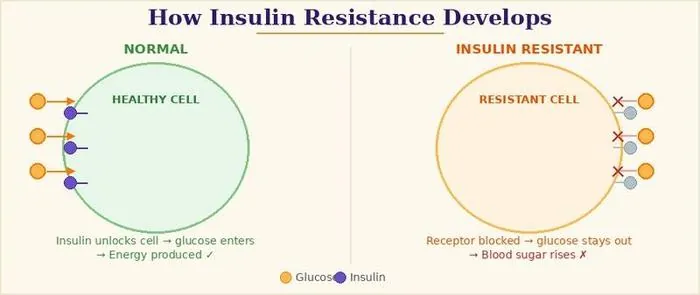
Start with insulin. In PCOS, your cells stop responding to it the way they should, so your pancreas compensates by pumping out more. That extra insulin does three things at once: it tells your body to store fat, mostly around the abdomen, it blocks the breakdown of fat you already have, and it pushes your androgen levels up, which makes you hungrier and drives cravings. Each of those effects feeds the next one. More fat means more resistance, more resistance raises androgens further, and higher androgens drive still more fat storage. It's a hormonal feedback loop, not a discipline problem, and no amount of willpower interrupts a feedback loop that food and lifestyle changes haven't addressed.
Why Calorie Restriction Fails for PCOS Weight Loss
"Eat less, move more" assumes your metabolism is working normally. In PCOS it usually isn't, and insulin resistance is the reason calorie counting so often backfires instead of working.
Cut calories hard without addressing insulin resistance and your body burns muscle before it touches fat, then the weight you lost finds its way back within a few weeks. That cycle isn't a sign you're doing something wrong. It's what happens when the intervention doesn't match the mechanism. Read the full biology of why dieting fails →
I have had a client cut her calories hard, lose weight fast, and then watch all of it return within a month, not because she lacked discipline but because her body was holding on tighter the harder she restricted. With another client who had the same frustration, I started from that same logic, eating enough and addressing the hormone side rather than cutting further, but the plan looked different by the time we were done, because what was actually driving her weight was not quite the same, and it took real trial and error to find what her body needed instead. PCOS weight loss rarely follows the same script twice, which is exactly why a generic calorie target keeps failing where a plan built around the person does not.
The Three Root Causes Behind PCOS Weight Gain
Three drivers tend to work together in PCOS weight resistance. Insulin resistance shows up in roughly 65 to 70% of cases and is usually the main metabolic driver. Androgen excess, elevated testosterone, specifically pushes fat toward the abdomen and slows the breakdown of stored fat. And HPA axis dysregulation, the chronic cortisol that comes from undereating or ongoing stress, works against insulin signalling and fat storage at the same time. Address only calories and leave these three untouched, and the weight tends to return within weeks.
This is also why the same insulin problem that makes weight stubborn in your twenties can turn into a blood sugar problem later on. It is the same road, further along, and the eating pattern that helps here is close to the one in the diabetes diet plan for India. If sugar has already been called borderline for you, or diabetes runs in the family, that guide is worth reading alongside this one.
High insulin leads to fat storage, which raises androgens, which worsens insulin resistance, which stores more fat. This self-reinforcing cycle doesn't break from calorie restriction alone, it needs the insulin piece addressed directly. ⚡ Understand insulin resistance fully →
Dunaif A. (1997) established that insulin directly stimulates ovarian androgen production independent of body weight, which is exactly the mechanism behind why calorie-cutting alone so often fails in PCOS. Read on PubMed →
Where PCOS Weight Gain Shows Up: Visceral Fat and the PCOS Double Chin
Fat distribution in PCOS looks different from ordinary weight gain. Most women with this condition build up visceral fat, the deeper layer that wraps around abdominal organs, even at a moderate overall weight. That's why so many women feel "puffy" around the middle without technically being overweight by the numbers.
| Type of Fat | Where It Sits | PCOS Impact |
|---|---|---|
| Subcutaneous fat | Under skin (thighs, hips, arms) | Less hormonally active; lower metabolic risk |
| Visceral fat | Around organs (abdomen) | Worsens insulin resistance, inflammation, and androgens |
| TOFI pattern | Normal weight but high visceral fat | Found in lean PCOS see Lean PCOS guide |
Facial changes follow the same pattern. Rising insulin and androgens can settle fat under the jaw and chin, which is why so many women notice what's often called a PCOS double chin even without much weight change anywhere else. Chin exercises and facial routines don't touch this, because it isn't a local fat problem, it's a hormonal one, and it tends to soften once insulin resistance is actually addressed.
The Insulin-First Approach to PCOS Weight Loss
Rather than counting calories, the work shifts to eating in a way that lowers your insulin response meal by meal. As insulin comes down, the fat-storage signal weakens, hormones start to settle, and weight loss becomes achievable again instead of feeling like a losing battle. For the full Indian meal plan built around this approach, see the PCOS Diet Chart India guide →
- Never eat carbs alone. Pair every carbohydrate with protein and fat, this slows glucose absorption and takes the edge off the insulin spike.
- Eat at regular intervals. Three main meals plus one or two small snacks, spaced roughly 3 to 4 hours apart. Skipping meals raises cortisol, and cortisol makes insulin resistance worse.
- Cut back on refined carbohydrates. Maida, large portions of white rice, packaged snacks, and sugary drinks produce the sharpest insulin spikes of anything on an Indian plate.
- Load breakfast with protein. Eggs, paneer, curd, sprouts, or besan blunt the morning glucose spike that otherwise sets a bad hormonal tone for the rest of the day.
- Reach for anti-inflammatory Indian foods. Methi, haldi, karela, alsi, and rajma each have specific evidence behind them for lowering insulin resistance.
- Put more carbohydrates earlier in the day. Insulin sensitivity is naturally higher in the morning and drops off by night.
Skipping breakfast raises cortisol, your stress hormone. Elevated cortisol directly increases androgen production and worsens insulin resistance, so it works against the exact thing you're trying to fix. Regular meal timing consistently outperforms fasting protocols for women managing PCOS.
Indian Diet Solution for PCOS Weight Loss What to Eat
Indian Meal Examples for PCOS Weight Loss
| Meal | Example | Why It Works |
|---|---|---|
| Breakfast | 2 eggs + palak + 1 multigrain roti OR moong dal chilla + curd | High protein prevents insulin spike; sets stable blood sugar for the day |
| Mid-morning | A small handful of mixed seeds (alsi, pumpkin, sunflower) or a small bowl of curd | Zinc and omega-3 from seeds support hormone balance |
| Lunch | Dal + 1–2 phulkas + sabzi + salad with lemon dressing | Complete protein + fibre slows glucose absorption |
| Evening | Roasted chana or a small bowl of sprouts | Prevents energy crash that triggers cravings |
| Dinner | Light dal or grilled paneer + sautéed vegetables + small portion of rice or 1 roti | Front-loads carbs earlier; lighter evening meal supports overnight repair |
Foods That Lower Insulin Resistance
A Sample Week: Putting the Insulin-First Approach Into Practice
| Day | Focus | Example Tweak |
|---|---|---|
| Mon, Wed, Fri | Strength training days | Protein-heavy breakfast before training; carbs front-loaded at lunch |
| Tue, Thu | Walking + yoga days | 20-min post-meal walk after lunch and dinner |
| Saturday | Flexible/social day | Pair any festive meal with protein first, walk after |
| Sunday | Reset day | Meal prep for the week; earlier dinner to protect sleep |
This isn't a rigid plan, it's a rhythm. The goal is consistent meal timing and daily movement, not a perfect score on any single day. If you would rather start from your own reports than from a sample week, this is what goes into a personalised diet plan.
Foods to Avoid for PCOS Weight Loss
- High-GI carbs, white rice in large portions, maida rotis, sooji upma
- Sugary snacks & drinks, mithai, packaged juices, cold drinks, energy drinks
- Refined seed oils, sunflower and soybean oil in excess promote inflammation
- Skipping meals, creates cortisol spikes that worsen insulin resistance
- Late-night heavy meals, impairs overnight metabolic repair
Common PCOS Weight Loss Myths, Debunked
Myth: "You need keto or intermittent fasting for PCOS"
For many women, extreme low-carb diets and fasting protocols push cortisol up, which raises androgens and worsens the exact insulin resistance you're trying to fix. A moderate-carb, protein-anchored Indian diet eaten on a consistent schedule beats extreme restriction for most PCOS phenotypes.
Myth: "If the scale isn't moving, you're not trying hard enough"
Insulin resistance can mask fat loss for weeks. Muscle gain, less water retention, and reduced bloating don't always show up on a scale, even while your body composition is genuinely changing. Waist measurement and energy levels are usually better early indicators than weight alone.
Myth: "Birth control fixes the underlying weight issue"
Hormonal contraception can regulate your cycle and calm acne, but it doesn't touch insulin resistance, the actual metabolic driver behind PCOS weight gain. Plenty of women find their weight stalls or climbs on the pill specifically because the insulin problem was never addressed.
Myth: "PCOS weight gain is the same for every woman"
It isn't. Insulin-resistant PCOS, adrenal-driven lean PCOS, and post-pill PCOS each gain weight through a different mechanism and each needs its own strategy. See how lean PCOS differs →
Realistic PCOS Weight Loss Timeline
| Timeframe | What Changes | Why It Matters |
|---|---|---|
| Weeks 1–3 | Bloating reduces, energy improves, fewer cravings | Inflammation coming down; blood sugar more stable |
| Weeks 4–6 | Periods may regulate; 1–2 kg reduction | Insulin lowering; androgens beginning to drop |
| Months 3–6 | 0.5–1 kg/month consistent loss; acne and hair fall improve | Hormonal environment is meaningfully shifting |
| 6–12 months | Significant body composition change; cycles regularising | Sustainable reversal, not just weight loss but PCOS remission |
When to Seek Professional Help for PCOS Weight Loss
It's worth bringing in a nutrition specialist if three months of consistent changes haven't moved the needle, if your fasting insulin is sitting above 15 µIU/mL, if your HOMA-IR is above 3, if you're noticing extreme fatigue, hair loss, or worsening period irregularity alongside the weight changes, or if your BMI is in the obese range on top of a PCOS diagnosis. In these cases, guided nutrition intervention consistently outperforms self-managed dieting.
Why Stress and Sleep Are Part of the Weight Equation
Food does most of the heavy lifting here, but it isn't the whole story. Two things rarely come up in a PCOS conversation, chronic stress and poor sleep, and both quietly undo the food changes you're making, because they interfere with the same hormones you're trying to fix.
Cortisol and Androgen Overload
Under persistent stress, cortisol stays elevated, and for a hormonal condition like PCOS that's a real problem. Cortisol competes with the same receptor pathways as insulin, and it pushes your adrenal glands to make more androgens at the same time. The net result is more testosterone, more insulin resistance, and more fat storage, even when your plate looks perfect. Managing stress isn't a nice-to-have here, it's part of the actual metabolic reset.
Sleep Quality and Insulin Sensitivity
One night of bad sleep is enough to measurably lower your insulin sensitivity the next day. If your insulin function is already compromised, that adds up fast. Sleeping under 7 hours consistently tracks with higher fasting insulin, more ghrelin (the hunger hormone), and less leptin (the hormone that tells you you're full). Aim for 7 to 9 hours of uninterrupted sleep with a wake time that doesn't swing wildly on weekends.
What Kind of Movement Actually Helps
Long, intense cardio sessions can push cortisol to counterproductive levels. The movement that actually helps PCOS weight loss combines three things. Strength training two to three times a week builds insulin-sensitive muscle, the single most metabolically active tissue you have, and the fastest route to better glucose uptake. A 20 to 30 minute walk after meals, done daily, meaningfully blunts the post-meal glucose spike without raising stress hormones. And yoga or stretching lowers cortisol and supports the parasympathetic tone that PCOS recovery depends on.
Post-meal walking is more powerful than it gets credit for. Your muscles pull glucose straight out of the bloodstream just from contracting, no insulin required, so a 15-minute walk after lunch or dinner does work your pancreas would otherwise have to do alone.
Exercise for PCOS: What Helps and What Backfires
Most PCOS exercise advice lands on one of two extremes: "just walk more," or a punishing HIIT programme. Both miss the actual point. For PCOS, exercise isn't primarily about burning calories, it's about making your muscles more insulin-sensitive. That's a different goal, and it calls for a different approach.
| Type | Effect in PCOS | How Much |
|---|---|---|
| Walking after meals | The highest-return habit available. Muscles pull glucose from the blood without needing insulin, directly lowering the post-meal spike. | 15–20 min after your largest meal |
| Strength training | Builds muscle, which is where most glucose is stored. More muscle means more glucose storage capacity and permanently better insulin sensitivity. | 2–3 sessions weekly |
| Yoga | Lowers cortisol, which matters enormously in lean and adrenal PCOS. Restorative styles outperform aggressive power yoga here. | 3–4 sessions weekly |
| Moderate cardio | Useful for cardiovascular health and mood. Not the main lever for PCOS weight. | As you enjoy it |
| Daily HIIT / heavy cardio | Often counterproductive. Raises cortisol, which raises androgens, especially damaging in lean PCOS. | Once weekly at most, if at all |
Walk for fifteen to twenty minutes after your largest meal of the day. Not before, not fasted, not at 6 am, after eating. It lowers post-meal glucose more reliably than almost any other single habit, needs no equipment, and works from day one. Everything else here is useful, but this specific timing is where most of the metabolic return sits.
Why HIIT Can Make PCOS Worse
This one surprises people, because intense exercise gets sold as the fastest route to fat loss. But in a body already carrying elevated cortisol and androgens, daily high-intensity training just adds another stress signal on top. Cortisol rises, androgens follow, cycles get more irregular, and the weight gets more stubborn instead of less. For lean or adrenal PCOS especially, this is one of the most common reasons a woman doing everything "right" ends up worse off rather than better.
When PCOS Weight Loss Stalls: Reading the Plateau
Almost every woman with PCOS hits a point where the scale simply stops moving. Before assuming the answer is eating even less, which is usually the worst response available, work through these first.
Ozempic, Mounjaro and GLP-1 Drugs for PCOS: My Honest View
I get asked about this constantly now, so here's a straight answer instead of a dodge.
GLP-1 medications genuinely do work for weight loss, and there's real emerging evidence of benefit in PCOS specifically. They improve insulin sensitivity, and the weight loss itself often brings ovulation back. If you and your doctor decide one is right for you, I'm not going to tell you that's a failure of any kind.
But there are a few things worth knowing before you start that rarely make it into the marketing.
The drug itself isn't the problem. The problem is using it instead of the nutrition work rather than alongside it. On a GLP-1 you'll be eating far less, which makes protein and nutrient density matter more, not less, or you lose muscle along with the fat and end up metabolically worse off than when you started. Whether to use one of these medications is a conversation for you and your doctor. My job is making sure whatever you do eat is doing everything it can, so what you gain sticks around after you stop.
Frequently Asked Questions
📖 Explore More PCOS Topics
Each guide covers one specific aspect of this condition in depth with Indian food strategies, symptoms, and what to do next.
PCOS Diet India
Complete Indian meal plan and food list what to eat and avoid for hormonal reversal.
Read Guide → SkinPCOS & Acne
Why this hormonal condition causes jaw acne and which foods clear your skin from inside.
Read Guide → HairPCOS Hair Loss
Crown thinning, DHT, and nutritional interventions that actually help hair regrowth.
Read Guide → CyclesIrregular Periods & PCOS
How to restore cycle regularity and what anovulation means for your hormones.
Read Guide → Lean PCOSLean PCOS Guide
PCOS in thin women adrenal-driven type, completely different approach needed.
Read Guide → InsulinInsulin Resistance Hub
The full guide to insulin resistance the root cause behind most weight issues in polycystic ovary syndrome.
Read Hub → Weight ScienceWhy Dieting Isn't Working
The biology behind why calorie restriction fails and the metabolism-first approach that does work.
Read Guide → Bone HealthOsteoporosis in Indian Women
How hormonal imbalance and crash dieting reduce bone density and what to eat to protect your bones.
Read Guide → Blood SugarDiabetes Diet Plan India
What to eat for steady blood sugar, and how it connects back to insulin resistance.
Read Guide → Hindiइंसुलिन रेजिस्टेंस (हिंदी)
The same insulin resistance guide, in Hindi.
Read Guide → Storyनमिता की कहानी
Namita's own insulin resistance story, in Hindi.
Read Guide → StoryMy Insulin Resistance Story
Namita's own experience with insulin resistance, in her words.
Read Guide → HindiPCOS क्या है (हिंदी)
PCOS symptoms, types and the Indian diet approach, in Hindi.
Read Guide → Main GuidePCOS Complete Guide
The full pillar guide covering all PCOS types, causes and the Indian diet approach.
Read Guide → PMOSPCOS Renamed to PMOS
What the May 2026 rename means, and what does not change for your care.
Read Guide → ThyroidThyroid Diet Plan India
What to eat when an underactive thyroid is making weight and energy harder.
Read Guide → Hindiवजन कम करें, सही तरीका
Weight loss, in Hindi, with hormones and food explained together.
Read Guide → Weight GainWeight Gain Diet Plan
For men and women who stay thin, and why lean PCOS needs a careful approach.
Read Guide →