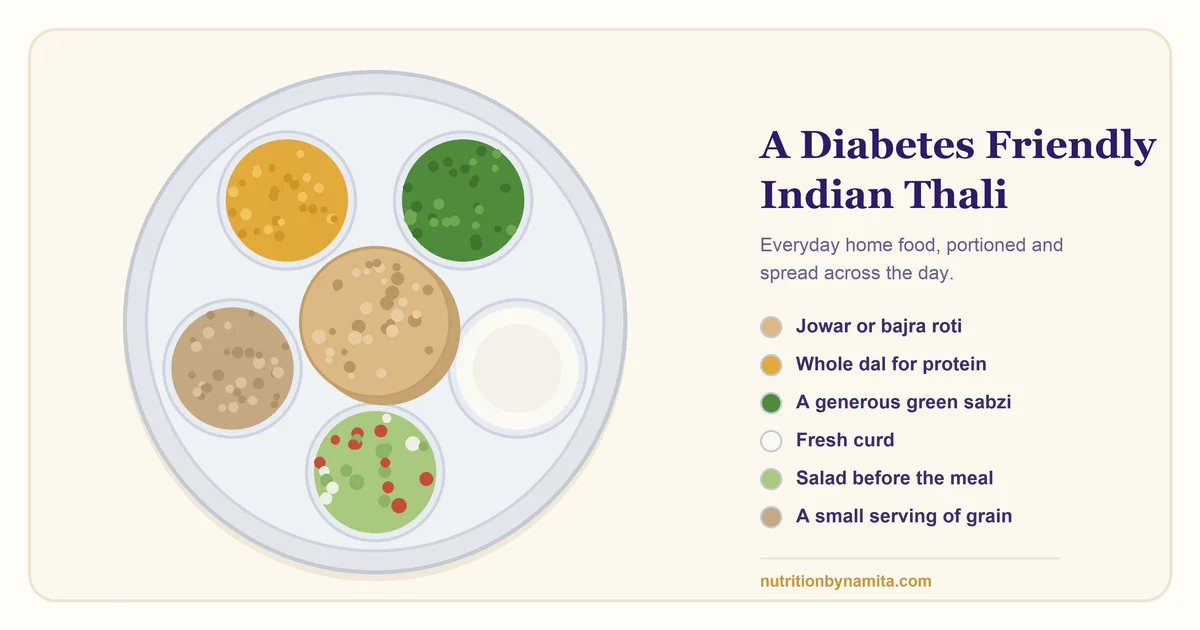
A diabetes diet in an Indian home is mostly the food already cooking in your kitchen, put together differently: bajra, jowar or ragi roti instead of maida, a full bowl of dal, green vegetables filling a good part of the plate, curd with meals, and whole fruit rather than juice.
Why Food Is the First Lever in Diabetes Management
Every single thing you eat passes through the same system that is already struggling. That is what makes food the one lever you get to pull three or four times a day, every day, without a prescription. Medicines matter and your doctor's plan matters, but they are working against whatever arrives on your plate. Change the plate and you change how hard everything else has to work.
What people usually notice first is not a number on a report. It is the afternoon slump that arrives like clockwork after lunch. The sweet craving at four o'clock that feels almost impossible to argue with. Waking up tired after a full night's sleep. Wounds that take their time healing. These are the things that shift first when the food changes, often within a few weeks, and long before anything dramatic shows up in a test.
There is no separate diabetic food you need to hunt for at your local kirana store or supermarket. Everything in this guide is roti, dal, sabzi, curd, fruit and salad. What changes is which grain, how much of it, what sits next to it, and when you eat it.
The Diabetes, PCOS and Insulin Resistance Connection
Diabetes rarely arrives out of nowhere. It sits at the end of a long road that usually starts with insulin resistance, sometimes ten or fifteen years earlier. Insulin is the messenger that tells your cells to take sugar out of the blood and use it. In insulin resistance, the cells stop listening properly, so the body sends more and more of the messenger to get the same job done. For years, a routine sugar test looks perfectly normal while all this is happening quietly underneath.
Type 2 diabetes is what happens further along that same road, when the body can no longer keep producing enough to compensate. This is why the eating pattern that helps one helps the other, and why the two conditions run in the same families.
The same mechanism sits underneath PCOS in a great many women, which is why a woman managing PCOS in her twenties is often the same person being told about borderline sugar in her forties. If you have PCOS, the food principles here are not a new plan to learn. They are the ones you are likely already following, and the detailed version lives in the PCOS diet guide. Where weight has been the stubborn part of that story, the PCOS weight loss guide works through the same sugar problem from the weight side, and why dieting isn't working explains why cutting food harder tends to make both worse rather than better.
An underactive thyroid often sits in this picture too, since it slows the pace at which the body uses energy and can make sugar harder to keep steady. If that has also been mentioned to you, the thyroid diet plan covers the food side of it, and it overlaps closely enough with this page that you are not looking at two separate diets.
If someone in your family has diabetes, or you have PCOS, or you have been told your sugar is borderline, you are standing earlier on the road than the person already diagnosed. Everything on this page works better the earlier it starts, and it works best of all before a diagnosis exists.
How Uncontrolled Sugar Quietly Weakens the Whole Body
This is the part almost nobody explains, and it matters more than the reading on the machine. When sugar stays high year after year, it does not politely stay a sugar problem. Your body needs to get energy from somewhere, and when it cannot use the sugar in your blood properly, it starts breaking down muscle to keep going. Slowly, quietly, over years. Nobody notices it happening.
What people do notice is everything that follows. Arms and legs that look thinner while the stomach does not. Stairs that feel harder than they used to. A jar lid that will not open. Getting up off the floor with a hand on the knee. Feeling drained by four in the afternoon in a way that sleep does not fix. That is not simply age. That is strength being lost in the background.
And muscle is not just about looking strong. Muscle is where a large share of the sugar in your blood gets used up. So losing it makes the original problem worse, which drains more muscle, which makes it worse again. That loop is the real reason uncontrolled sugar tends to open the door to other problems over time, from tired kidneys to numb or tingling feet to eyes that need more frequent checking. Left alone long enough, sugar stops being one condition and becomes several.
None of this is said to frighten anyone. It is said because it is fixable, and because it is the strongest argument there is for eating enough protein and moving your body, not just cutting sugar. A body that keeps its strength handles high sugar far better than one that has quietly given it away.
Indian Foods That Help, and Foods That Spike Sugar
The honest short version: whole beats refined, and whatever you eat alongside the grain matters as much as the grain itself.
Foods that keep sugar steady
- Millets: bajra, jowar and ragi rotis release their energy slowly and keep you full much longer than a maida roti or a large plate of white rice.
- Whole dals and legumes: chana, rajma, moong, masoor. The protein and fibre together slow down how quickly anything on that plate reaches your blood.
- Curd and paneer: everyday protein that most Indian kitchens already stock. A bowl of curd with a meal genuinely changes how that meal behaves.
- Green vegetables in real quantity: palak, methi, lauki, bhindi, tinda, gobhi. Not a spoonful on the side. Enough to fill a good part of the plate.
- Nuts and seeds: a small handful of almonds, walnuts or roasted chana as a snack instead of biscuits.
- Whole fruit: jamun, guava, papaya, apple, orange. Eaten whole, not juiced. Juice removes the fibre and leaves the sugar behind.
- Everyday spices: methi seeds, dalchini, haldi. Not a cure, but they earn their place in daily cooking.
Foods that push sugar up faster than most people expect
- Maida in all its forms: bread, biscuits, naan, rusk, samosa, namkeen. This is the biggest single one in most Indian homes.
- Large servings of white rice on its own: rice is not banned. Rice eaten alone, in a big helping, with very little dal or vegetable, is the problem.
- Fruit juice, packaged shakes and sweetened drinks, including the ones sold as healthy.
- Potato and arbi as the main vegetable, especially alongside rice or several rotis.
- Sugar free packaged food: a biscuit with no added sugar is still made of refined flour, and refined flour behaves very much like sugar once you have eaten it.
- Chai and coffee with sugar, several times a day. Individually small, and quietly enormous by evening.
Nobody manages diabetes for thirty years by refusing every mithai at every wedding. Eat before you go so you are not arriving hungry. Take a small portion on a plate rather than grazing continuously. Then go back to your normal way of eating at the very next meal, not next Monday. One sweet is an event. Two weeks of eating around it is the actual problem.
I have seen this logic work beautifully. With one client, moving from maida rotis and white rice to bajra and moong dal, with a bowl of curd at lunch, changed her afternoon energy within weeks. With another client I started from the same underlying logic, a slower grain paired with protein at every meal, but not the same plan, because her daily routine, her digestion and her vegetarian preferences were completely different, and it took a few rounds of trial and error before we found the grains, dals and spices that actually suited her. That is the part a generic food list leaves out, the principle stays the same, whole over refined, protein alongside every carb, but the actual plan has to be built fresh around the person eating it, never copied from someone else's.
Managing Sugar Across the Whole Day, Not Just the Morning Reading
Almost everyone measures in the morning and judges the whole day by that one number. But your sugar is not high for one moment at dawn. It rises and falls after every meal you eat, and it is those rises, repeated day after day, that do the long term work.
The single most useful change most people make is not removing a food. It is redistributing food. One large meal asks the body to handle a great deal at once, and it responds with a sharp climb. The same quantity of food, split into smaller meals spaced through the day, produces gentler rises the body can actually manage.
In practice this means not skipping breakfast and then eating an enormous lunch. Not fasting all day and having one heavy dinner at ten at night. Something reasonable every three to four hours, so you never arrive at a meal so hungry that portion control stops being a decision you get to make.
Two more things that get overlooked completely. Water. Most people managing diabetes drink far too little of it, and mild dehydration makes readings look worse and makes tiredness feel worse. Keep a filled bottle where you sit and work through it. And a short walk after meals, even ten minutes around the house or the block. Walking after eating uses up sugar at exactly the moment it is entering your blood, and it is the highest return ten minutes in the entire day.
A Sample Day of Eating
This is a shape, not a prescription. Adjust it to your kitchen, your work hours and what your family already cooks.
On waking: a glass of water. If you like methi seeds soaked overnight, this is when to have them.
Breakfast: something with protein in it, not just carbohydrate. Besan chilla, moong dal chilla, vegetable oats upma with curd, or two idlis with sambar rather than four with chutney alone. Eggs if you eat them.
Mid morning: a small handful of nuts, or a whole fruit. This is the meal people skip, and skipping it is exactly why lunch becomes too large.
Lunch: salad first, then one or two millet rotis, a generous sabzi, a bowl of dal or rajma, and curd. If rice is part of your lunch, keep the serving modest and let the dal and vegetables carry the plate.
Evening: chai without sugar, with roasted chana, a few nuts, or sprouts. Not biscuits or namkeen, which is the habit that undoes an otherwise good day.
Dinner: lighter than lunch and earlier than you think, ideally two to three hours before bed. A roti with sabzi and dal, or a vegetable and paneer preparation with a small serving of grain.
After dinner: a ten minute walk. Then stop eating for the night.
Common Mistakes People Make
- Cutting out rice and roti completely. It works for about eleven days, then hunger wins and everything comes back at once. Reduce and rebalance instead of eliminating.
- Skipping meals to bring the number down. This usually backfires. You end up eating more later, and the body reads long gaps as a reason to hold on tighter.
- Trusting the sugar free label. Sugar free biscuits, sugar free sweets and diabetic mixes are still refined flour. Read what it is made of, not what the front of the pack claims.
- Eating almost no protein. Very common in Indian vegetarian homes, and it is the direct cause of the muscle loss described above. Dal, curd, paneer, sprouts, nuts, every single day.
- Fruit fear. Whole fruit is not the enemy. Fruit juice is a different food entirely.
- Stopping medicines because the reading improved. The reading improved partly because of the medicine. That decision belongs to your doctor, always.
- Giving up after one bad week. This is a long game. A poor week is a week, not a verdict.
Lifestyle Factors That Matter Alongside Diet
Sleep. A few short nights in a row will push your readings up on their own, no matter how carefully you ate. If your sugar has been stubborn despite good food, look at what time you are actually falling asleep.
Stress. Worry raises blood sugar directly. It is a real physical effect, not a figure of speech. This is worth knowing simply so you stop blaming the food on weeks when the food was fine.
Movement, especially the kind that keeps muscle. Walking is excellent and everyone should do it. But because of what uncontrolled sugar does to muscle, some form of resistance work matters too. Bodyweight squats holding a chair, standing up from a chair repeatedly, climbing stairs, carrying your own shopping. Keeping muscle is not vanity here. It is treatment.
Frequently Asked Questions
📖 Where to Go Next
Insulin Resistance Guide
The stage that comes before diabetes, and the Indian diet plan for insulin resistance that turns it around.
Read Guide → HormonesPCOS Complete Guide
Why the same sugar problem sits underneath PCOS, and what changes when you treat the cause.
Read Guide → DietPCOS Diet India
The detailed Indian food list and meal structure, useful for anyone managing blood sugar.
Read Guide → Work With MeSee Plans & Fees
What a consultation includes, what the guided programmes cover, and what each one costs.
View Pricing → Hindiइंसुलिन रेजिस्टेंस (हिंदी)
The same insulin resistance guide, in Hindi.
Read Guide → Lean PCOSLean PCOS Guide
PCOS in thin women, the adrenal driven type, and why it needs a different approach.
Read Guide → Storyनमिता की कहानी
Namita's own insulin resistance story, in Hindi.
Read Guide → StoryMy Insulin Resistance Story
Namita's own experience with insulin resistance, in her words.
Read Guide → Bone HealthOsteoporosis in Indian Women
Calcium rich Indian foods and why bone health matters earlier than most women think.
Read Guide → SkinPCOS & Acne
Hormonal jaw acne, the androgen connection, and foods that help clear skin.
Read Guide → HairPCOS Hair Loss
Crown thinning, the hormone behind it, and nutrition that helps regrowth.
Read Guide → HindiPCOS क्या है (हिंदी)
PCOS symptoms, types and the Indian diet approach, in Hindi.
Read Guide → CyclesIrregular Periods & PCOS
How cycle regularity comes back through food and lifestyle.
Read Guide → WeightPCOS Weight Loss
Why standard diets fail with PCOS, and the insulin first approach that works.
Read Guide → PMOSPCOS Renamed to PMOS
What the May 2026 rename means, and what does not change for your care.
Read Guide → ThyroidThyroid Diet Plan India
What to eat when an underactive thyroid is making weight and energy harder.
Read Guide → Hindiवजन कम करें, सही तरीका
Weight loss, in Hindi, with hormones and food explained together.
Read Guide → Weight GainWeight Gain Diet Plan
For men and women who stay thin, and why lean PCOS needs a careful approach.
Read Guide → Weight ScienceWhy Dieting Isn't Working
The biology behind why cutting calories fails, and what to do instead.
Read Guide →If you are new here, start from the home page to see how the consultations work, or go straight to plans and fees.
← Back to all articles- Anjana R.M. et al. (2023). Metabolic non-communicable disease health report of India: the ICMR-INDIAB national cross-sectional study. The Lancet Diabetes & Endocrinology, 11(7), 474–489. PubMed →
- Aune D. et al. (2013). Whole grain and refined grain consumption and the risk of type 2 diabetes: a systematic review and dose-response meta-analysis. European Journal of Epidemiology, 28(11), 845–858. PubMed →
- Lai H. et al. (2023). White rice consumption and risk of cardiometabolic and cancer outcomes: a systematic review and dose-response meta-analysis. Critical Reviews in Food Science and Nutrition, 63(33), 12476–12487. PubMed →
- World Health Organization. (2024). Diabetes. WHO Fact Sheet →

This article is nutrition guidance, not medical advice. Namita is a Certified Nutrition Coach, not a doctor. Please do not change prescribed medication without speaking to your doctor.